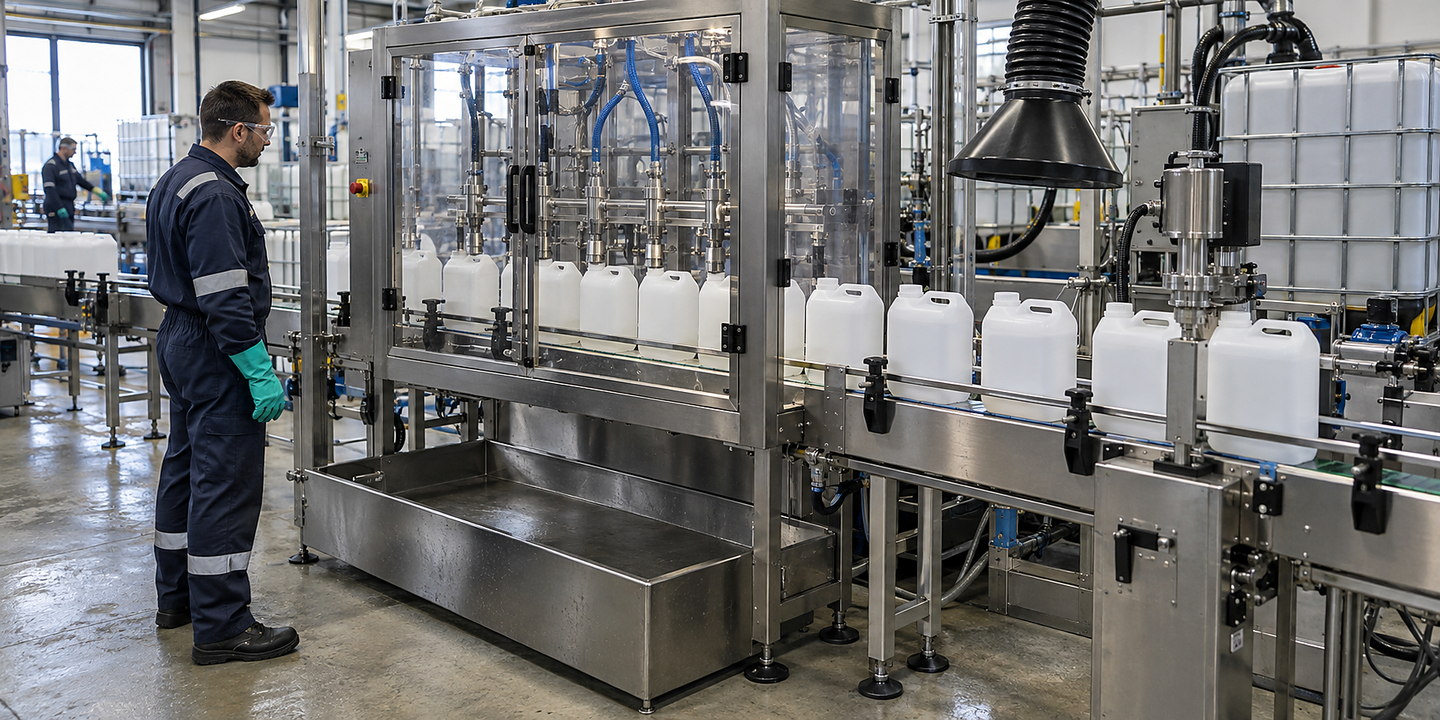
Compare lubricant filling proposals using actual oil or grease, filling condition and supply, supported containers, dose results, clean necks and grade-change trial evidence.
In brief
Compare proposals using the same lubricant grades, normal filling conditions and actual containers. Separate getting product to the dosing point from measuring the required quantity. Include container support, nozzle entry and cut-off, clean necks, product supply, closing/labelling connections and the operator work needed for the complete production pattern.
See how the complete system fits your production line — Lubricant Filling Machines
Plan lubricant filling machines around your product, pack range, target output, cleaning needs and finished-pack checks. Discuss a practical line concept with Lancing using representative samples. When you compare solutions, check how each option handles lubricating-oil & grease filling product behaviour, container, bag or pack range and your surrounding line.
Lubricant Filling Machines support from first review to production use
Understand your requirement
Provide identified lubricant grades/batches, viscosity with its temperature and measurement condition, target mass or volume and representative containers. Include cold-start or standing behaviour, foaming/stringing, the product supply route and known neck-cleanliness problems.
Compare suitable approaches
Compare pump, piston or weighing options using the same actual product conditions and container range. Retain individual fill results, foam/drips and nozzle withdrawal observations. A free-flowing oil demonstration does not prove grease handling, compatibility or an accuracy claim.
Fit the complete line
Agree vessel/drum supply, transfer distance and product level, container support and nozzle access, discharge and closing/labelling connections. Include operator/lifting tasks, change parts, replenishment, cleaning and the response to incomplete or visibly contaminated packs.
Prove and support the result
Record accepted filled containers and operator interventions through refill, pause/restart and the difficult container or grade change. Agree allowed carryover, draining/cleaning or dedicated contact parts with the product owner, retaining conditions, results and unresolved limits.
Typical support: line concept, trials, filling or packaging equipment, integration and handover.
Compare your options
Compare lubricant filling machines with simpler routes
Approach
Often suitable when
Watch for
Lubricant Filling Machines
You need a dedicated solution for a clearly defined duty, product or part range and line interface.
Chemical compatibility, vapour, dust and hazardous-area duties require substance-specific assessment.
Semi-Automatic Equipment for Lower-Volume or High-Changeover Work
Your volumes, product mix or operator judgement make a simpler route more practical.
Check ergonomics, consistency and safe access before choosing the lower-complexity option.
Fully Automatic Line Integration where Repeatable Container Flow and Rate Justify It
Your surrounding process is stable enough for a broader automated solution to add value.
Allow for line connections, fault recovery and maintenance as well as the headline equipment.
What to send us
Help us give you useful guidance
Representative Product and Container SamplesInclude the current revision and explain what this information should show for your operation.
Fill-Weight or Pack-Quality ResultsInclude the current revision and explain what this information should show for your operation.
Changeover and Cleaning ObservationsInclude the current revision and explain what this information should show for your operation.